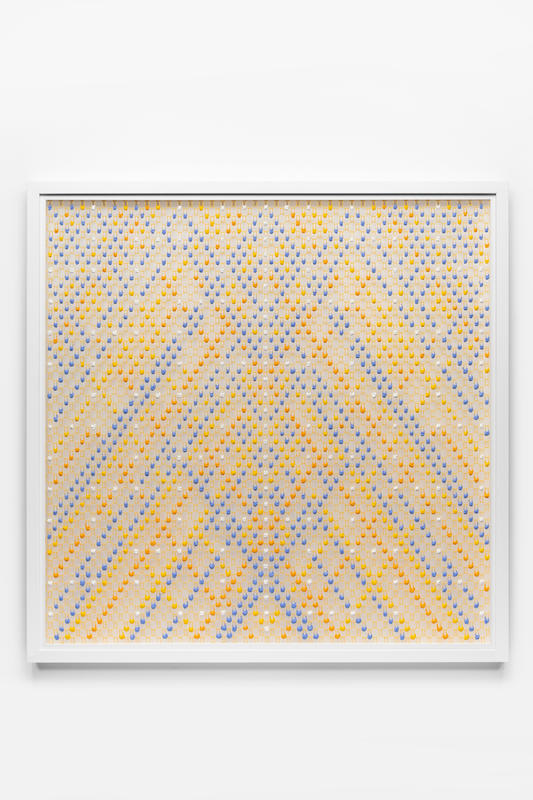
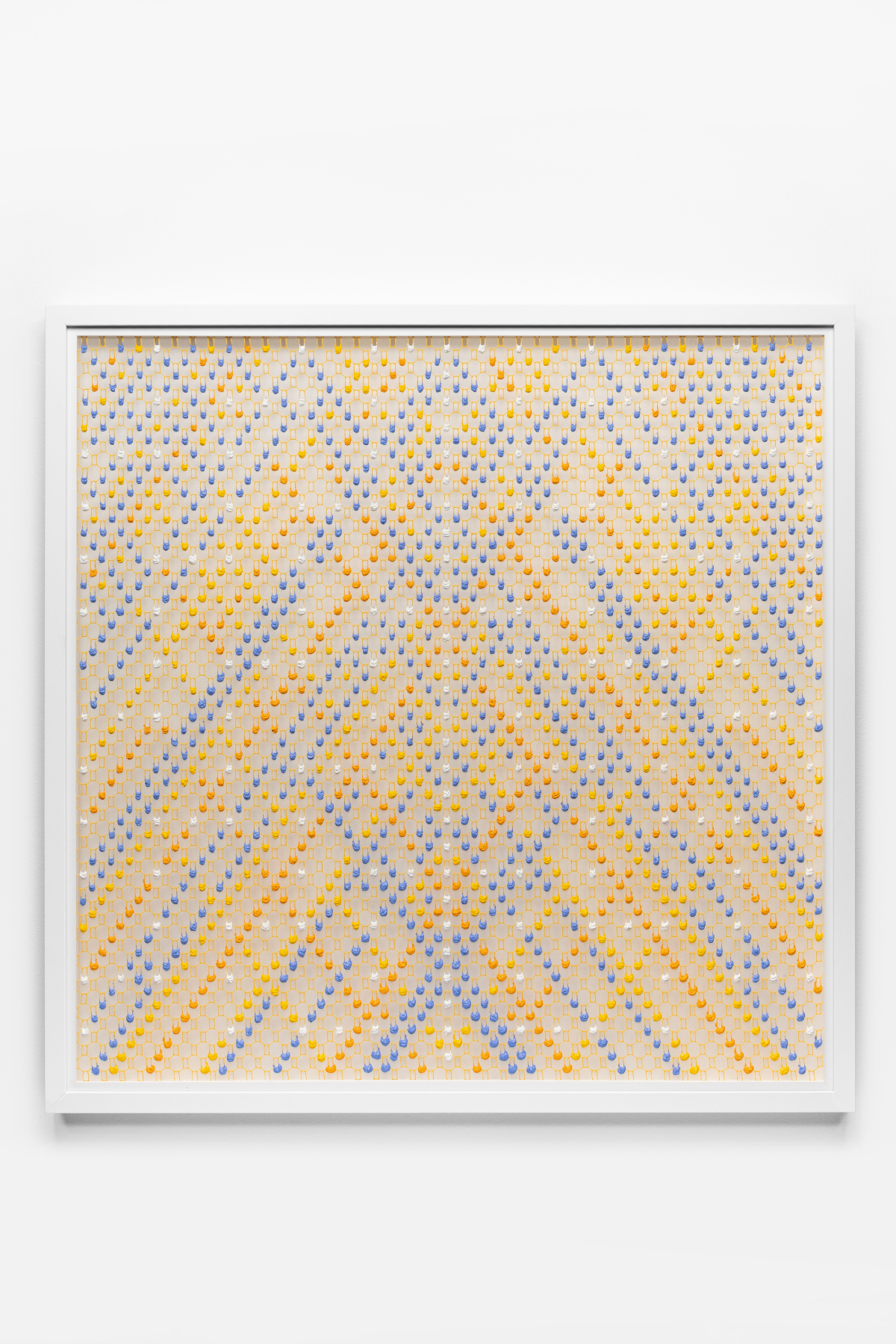
Peata Larkin, Kei konei koe_You are here, 2025, acrylic paint on embroidered silk, Chartwell Collection, Auckland Art Gallery Toi o Tāmaki.
Peata Larkin’s painting series Kei konei koe was a highlight of Sydney Contemporary 2025, where it was exhibited in a striking poutama formation with PAULNACHE Gallery. From this series, The Chartwell Collection acquired Kei konei koe_You are here. To mark the acquisition, Peata spoke with Chartwell about the painting and its kaupapa.
Chartwell: We’re talking in your studio in Onehunga, where paintings line the walls behind your easel. Do you often refer back to previous artworks when developing new work?
Peata Larkin: Always. There’s an evolution in my mahi but also a continuous kaupapa. I paint tukutuku, tāniko and raranga patterns as my visual and symbolic language, but as much as Te Ao Māori is the foundation of my mahi, there is another side that’s always going to be there because of who I am. As a painter, I understand that when I pick up a paintbrush it is loaded with history. When I was studying at Elam School of Fine Arts, Lucio Fontana was a huge influence on me, as were Bridget Riley and Agnes Martin, to name a few, and I think you can see these influences in my practice.
My work is autobiographical because the more I learn the more it comes out in my mahi. When I was at Elam, a lot of my work was about the painting process and experimentation. When I left I was creating to find out who I was. I have a show at Pah Homestead in May called Silent Kōrero, and I chose that title because that’s what my work is about. I didn’t grow up knowing about my Māori heritage, and I still cannot speak fluent Māori, so my healing process, who I am as a wahine, and my language comes through my paintings.
Chartwell: Kei konei koe_you are here is an artwork in a mode you’ve been exploring since 2018: painting on embroidered silk. How did you arrive at this form?
Peata: I’m a magpie. I go around and find different materials. I work on a lot of grid materials like mesh. I was excited when I came across this embroidered silk because yellow is a deeply meaningful colour to me. When I was a child, yellow was my happy colour, my safe colour. There was a time when I’d only wear yellow.
When I first found the silk, I didn't know what I wanted to do with it so it sat in my studio for about six months. Then one day I simply sat down and began painting. It felt completely natural. The majority of my artwork involves approaches which allow me to create a tactile surface where I can work from the back—using open grids, transparency, or cutting into the canvas—so the transparency was especially important. I love working with the interplay of light and shadow.
Chartwell: How have your silk works changed since 2018?
Peata: At the start they involved specific patterns, such as the poutama and the aramoana, a mnemonic language of my tīpuna. But over the years, a complexity emerged as I found that these works were more than just about honouring my tīpuna. I’m in dialogue with them. When I paint, my tīpuna are present with me. I go into another place when I paint, and sometimes I’m in that state for hours.
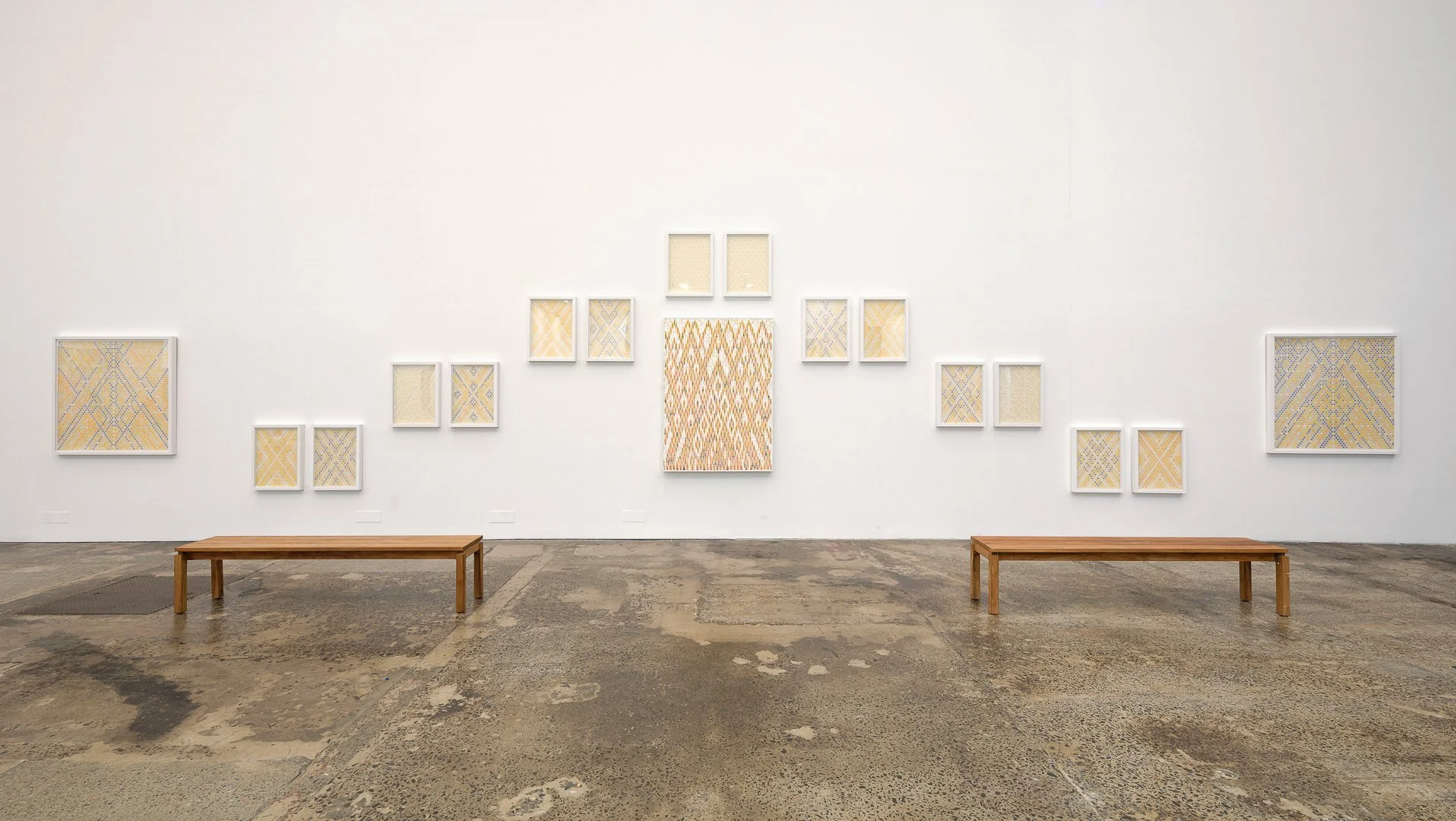
Kei konei koe_You are here, far right, installed with Paul Nache Gallery at Sydney Contemporary 2025.
Chartwell: Could you talk about your palette for these works: the yellow, white and blue?
Peata: Colour has always had a symbolic and personal meaning for me. My Pink and White Terraces works, the I Am Tūhourangi series, are predominantly pink and white Poutama from afar, but up close there are sulphuric greens, blues and ochres that evoke Rotomahana, the lake and the bushes, and the coming together of those elements. I deal with colour as a rhythm that evokes memory and sensation, an approach that stuck with me from my studies of Bridget Riley and Agnes Martin.
In the silk works, the yellow is the wairua. It’s my being.
The white is the bones or the skeleton of the painting.
The blue is the environment, the whenua, everything. The blue came in when I began working with Whiti Hereaka, my cousin, on the book You Are Here. I created a painting on graph paper, and I loved the push and pull of the light blue grid and the vibrant textural yellow paint so my You Are Here series grew from that little work.
Chartwell: Your You Are Here exhibition at Two Rooms last year was the first time you created a collection of paintings with a singular outcome in mind. Was it collaborating with Whiti that prompted this change in approach?
Peata: Yes, I used to paint until I had a body of work I was happy to share. For You Are Here, something about the process of working with Whiti brought up a strong vision of what I wanted to do. In the book, she writes about going to the wharenui and seeing the familiar faces and feeling that this is where she belonged. So that’s what every single work in You Are Here represented: belonging, but in the sense of a wharenui.
At Sydney Contemporary—where the subsequent series Kei konei koe was exhibited—I saw this show as me introducing myself to the Australians, saying “Kia ora, I am here.” And that’s why Mahuika was there, as a way of putting myself in this time and place, bringing me strength in a foreign place and why Kei Konei Koe was arranged as a poutama, because it was about whakapapa.
Chartwell: Painting can make such unique contributions to how we think about the structure, purpose and potential of language. What is language to you as a painter?
Peata: Language is so multi-faceted. There’s the history of painting that is language, then there’s my Māori heritage, my whakapapa. And there’s the languages of aesthetics, composition and colour, all these different layers we deal with. When I read Whiti’s draft of our book, You are here, it was like reading one of my paintings. It covered all those things: Who I am as a person, which includes the influences that shape me and my practice, and being Māori but severed from my Māori heritage; my journey back to my tīpuna, and the whakamā that I felt or still feel sometimes.
All of that is what creates that language, as much as the personal and symbolic colours that run through my work. And when you put it out in the world for people to experience, it's up to them how they read it. I know why my mahi is created and I’m ready to share it, to let it go.
Featured Artworks