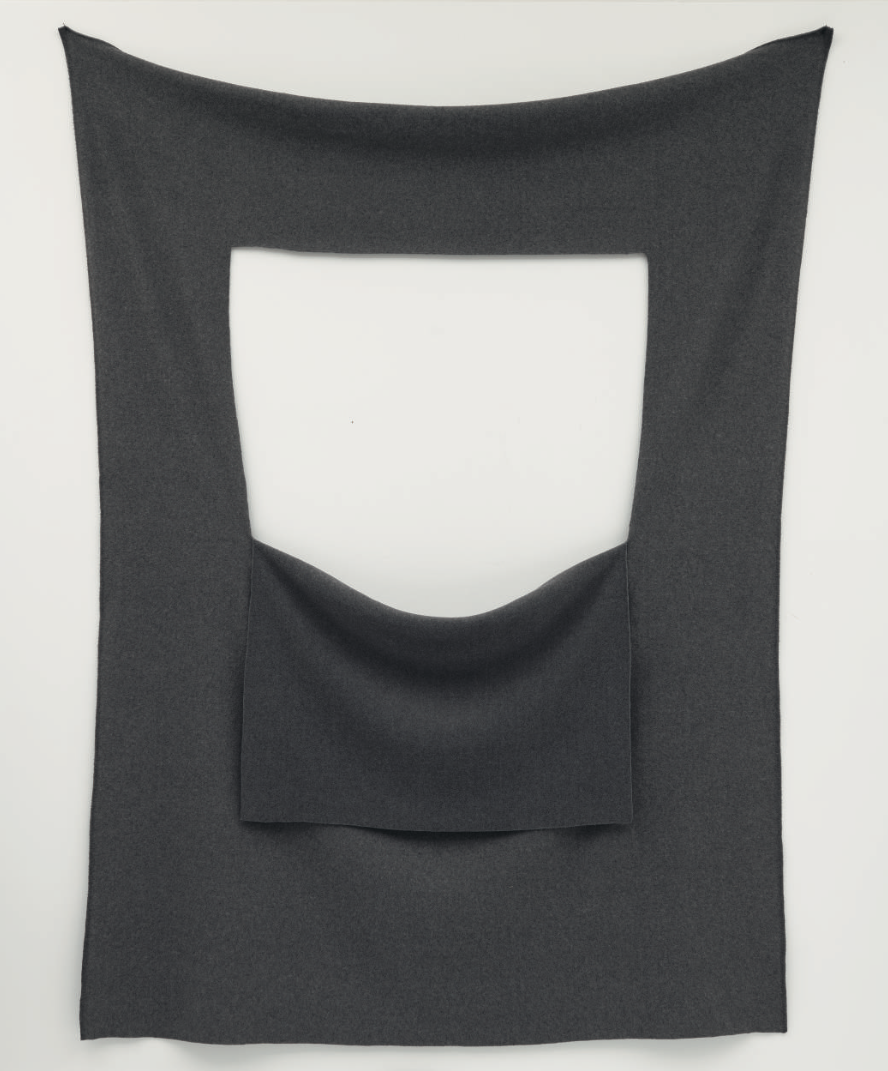
Untitled by Elizabeth Newman (2004), polar fleece fabric, Chartwell Collection, Auckland Art Gallery Toi o Tāmaki.
This essay is from Being, Seeing, Making, Thinking: 50 Years of the Chartwell Project, available for purchase here.
The large, vertical rectangle of grey polar fleece that forms the base of Australian artist Elizabeth Newman’s Untitled, 2004 stretches and slumps under the pressure of three incisions that form three sides of a square. Succumbing to gravity, a window-like flap droops down from the cuts, negating the warmth of the base material and revealing the bare wall behind.
Untitled is part of the early period of Newman’s return to art, after a hiatus in the 1990s to study psychoanalysis, which she still practises. This profession is evidenced in the psychological and referential nature of her artworks, including a preoccupation with holes and other absences. A fissure into concealed depths, the main presence of Untitled’s gesture is a void, with the fabric itself becoming a frame to the non-space.
Untitled is more subdued in its referentiality to modernist paintings than, say, After Ellsworth Kelly, 2006 – another of Newman's works in the Chartwell Collection, for which the artist replicated two classic Kelly shapes and colours as large pieces of fraying fabrics. However, Untitled does echo a number of mid-20th century artists and their formal preoccupations.
Untitled stretches out the approach of predecessors like Lucio Fontana, for example, to new ends. In comparison to the stabbing action that penetrates Fontana’s canvases, Newman’s carved, drooping fleece appears more organic, less phallic, and scoops in a larger dollop of bathos. On these terms, the work is more aligned with post-minimalist icon Eva Hesse.
Newman’s materiality and her works’ relationship to what is vulnerable and exposed, as well as to what is powerful and hidden, resonate with Hesse’s. However, Newman embraces humorous analytical wordplay and association games in a way that Hesse – a child refugee of the Holocaust and, like Fontana, a postwar artist – does not.
Closer to home, Untitled alludes to Australian artist Sidney Nolan’s 1946–47 Ned Kelly series of paintings, which depict the eponymous 19th-century folk icon in his home-made armour. During his final battle against police, although the armour shielded Kelly’s human frame and gave him an intimidating super-human silhouette, he was eventually wounded through the cracks and brought down. Newman’s transformation of this larger-than-life figure’s great helm into a huge, sagging form is a reminder that, even in armour, the skin is soft, limp, ready to be cut open.
Casey Carsel is a writer and artist. Their works of poetry, fiction and non-fiction have been published by Documentarian, Tipton Poetry Review, Hamster, West Space, Ocula Magazine and elsewhere.
Featured Artworks


